

Celebrating Asian American and Pacific Islander Heritage Month: A Journey of Resilience and Hope
View more

This February, Hilti North America showed once again that when an organization invests in people, culture, and courageous conversation, the impact echoes far beyond a single month of recognition.
Throughout Black History Month, our Black Employee Resource Group (ERG) curated a lineup of thoughtful, energizing, and deeply connective experiences across the U.S. and Canada. From empathy centered learning to intersectional collaboration, historical reflection, and community storytelling, this year’s observance brought team members together in meaningful ways.
We kicked off the month with Dr. Nicole Price, who delivered a call‑to‑action around authentic empathy. She reminded us that “empathy cannot sit on a bed of hypocrisy,” urging team members and leaders alike to align actions with values.
Her session highlighted an important truth: empathy is not passive nor a soft skill that can be trained in one session - it’s a daily practice reflected in how we show up for one another – authentically. And one of the tools she provided was that we must maintain shared hope – we must work together and celebrate even the smallest progress. There are people at the end of our data points!
Dr. Price dropped many valuable gems in this session that can truly give people a strong boost in their careers. My biggest takeaway was how powerful emotional clarity truly is. She introduced the R.U.L.E.R. method to us, which is a research-based framework from the Yale Center for Emotional Intelligence that helps people recognize, understand, label, express, and regulate their emotions with more clarity and intention.
My personal takeaway from this session is how powerful emotional clarity truly is. Learning about the RULER method encouraged me to be more intentional about expressing my emotions in healthier and more context‑appropriate ways, rather than suppressing them or allowing them to spill out unchecked.
Dr. Price emphasized that suppressed feelings never die, so it’s important to address them proactively. The idea that emotions can be regulated with thoughtful strategies reassured me that I have more agency in difficult moments than I sometimes realize. Since the session, I have been more diligent about putting these practices into action.
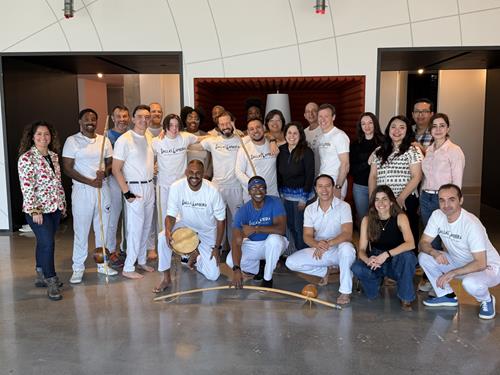
The Latinx Unidos event on February 13.
Next, we partnered with the Unidos (Latinx) ERG for an eye‑opening conversation exploring the intersections of Latinx and Black/African identities. Through shared narratives, cultural reflection, and moments of unity, team members learned how our histories intertwine more than we often realize.
The session closed with a high‑energy Capoeira performance that infused the room with rhythm, movement, and joy — a perfect celebration of cultural fusion.
This session resonated deeply with me, especially after witnessing Bad Bunny’s Super Bowl performance, which highlighted the often‑erased African roots within Latin American culture. It reminded me how millions of Africans, forced into Latin America through enslavement, shaped the region’s music, language, spirituality, and identity—yet their stories were pushed into the margins.
Seeing those influences displayed so boldly on a global stage felt like long‑overdue acknowledgment, and it reinforced the session’s message that Black and Latinx histories are profoundly intertwined. I left feeling proud, re‑energized, and hopeful, reminded that representation heals, visibility matters, and our cultures and futures are more connected than we often realize.
Our third major session invited team members into a courageous conversation about The Nickel Boys by Colson Whitehead — a book (and later film) based on the real, painful history of Florida’s Dozier School for Boys.
Led by The Black Librarian Crew founders, Ashley Mitchell and Dwyn Griffin, the discussion centered on:
It was a heavy session — but necessary, grounding, and deeply reflective. The Nickel Boys session left a profound impact on me. Confronting the real history behind the Dozier School underscored how systems can fail children—especially Black boys—when protection, accountability, and humanity are absent. The heaviness of the story made the takeaway even more urgent: we all carry a responsibility to challenge injustice, amplify truth, and ensure that the environments we build today don’t mirror the failures of the past.
Also, I reflected on the kind of leader I want to be — one who not only avoids harm, but actively creates safety, accountability, and inclusion. It reinforced that Diversity, Equity and Inclusion isn’t optional or “nice to have”; it’s a core leadership responsibility. I want to lead in a way that protects people, amplifies underrepresented voices, and prevents the kinds of systemic failures that we have seen in all types of communities.
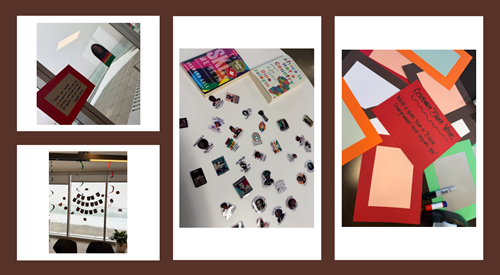
Different projects done around HNA for Black History Month.
Our Canadian counterparts also made this month unforgettable. The MO Canada OWNIt! Team transformed their lunchroom into a cultural learning space by sharing:
These displays invited team members to learn, engage, and discover during their everyday routines.
On February 25, they hosted a special luncheon to honor Black History Month — a warm, community‑driven moment of togetherness that expanded the celebration across Hilti North America.
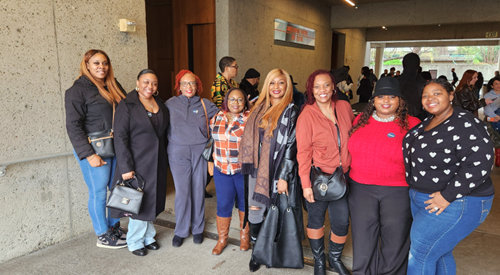
Running alongside our formal programming, our voluntary Let’s Meet Up gatherings once again gave team members an opportunity to connect outside their day‑to‑day roles. The “Let’s Meet Up” gatherings are important because they create an intentional space for authentic connection outside of daily work responsibilities. These informal moments help team members build trust, strengthen relationships, and develop a greater sense of belonging. By bringing together people who might not interact day‑to‑day, the meet‑ups encourage cross‑team community, support psychological safety, and reinforce a culture where people feel seen, valued, and included.
This year included:
Many of the places visited are Black owned, which is one of our goals during BHM to support Black business.
One of the most powerful learnings came from the meetup at Van Cortlandt Park in the Bronx, NY, where participants learned that the area — now recognized as a burial ground — had long been walked over as a park. Only last year, after community advocacy, was the space formally acknowledged and protected.
Formally acknowledging the burial ground at Van Cortlandt Park is deeply meaningful because it restores dignity to people whose lives and histories were overlooked for generations. For the Black community, actions like this counter centuries of erasure by honoring ancestors who were denied recognition in life and in death. These acknowledgments validate lived experiences, protect sacred spaces, and ensure that future generations learn a fuller, more truthful history. Beyond the Black community, they remind all of us that healing, justice, and progress begin with truth—because when a community’s past is respected, its people feel seen, valued, and included in the narrative of our shared history.
The realization struck everyone:
How many ancestors and histories go unrecognized until someone raises their voice?
And in that same spirit, how many voices inside the workplace go unheard until someone chooses to speak up? Both questions point to the same truth—visibility, acknowledgment, and courageous advocacy are essential to building environments where people feel respected, protected, and truly included.
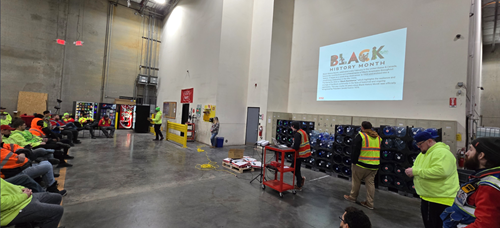
A Black History Month presentation at a Hilti distribution center.
Black History Month at Hilti North America was truly one to remember. Each event — from the U.S. to Canada — uplifted community, encouraged deeper understanding, and reinforced the power of empathy, representation, and cultural appreciation.
We are grateful to work in an organization that invests in its people and celebrates diversity not as a checkbox, but as a shared responsibility and value.
As we move forward, let’s continue carrying out these learnings with us. What’s one small step you can take to practice authentic empathy, amplifying underrepresented voices, or improving your leadership style?
At Hilti, we are committed to creating opportunities for our team members to connect to one another and develop meaningful and long-lasting careers with impact. Learn more and explore our opportunities in North America and worldwide here: Jobs | Hilti Careers

